A woodblock print is not a reproduction of a painting. It is an object made by a sequence of physical transfers, each of which introduces its own small deviation. Understanding the sequence is the fastest way to understand what you are buying.
1. The drawing
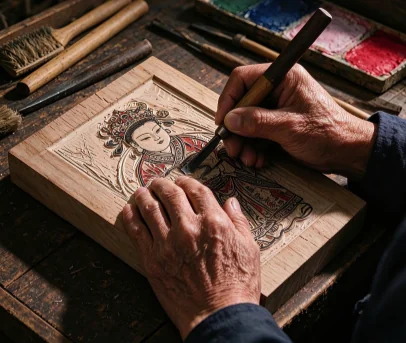
The design is drawn on thin paper and transferred, in reverse, onto a block. Mirror image is not a detail — the block prints what it is given, so the carver works backwards for the whole of the job.
2. The blocks
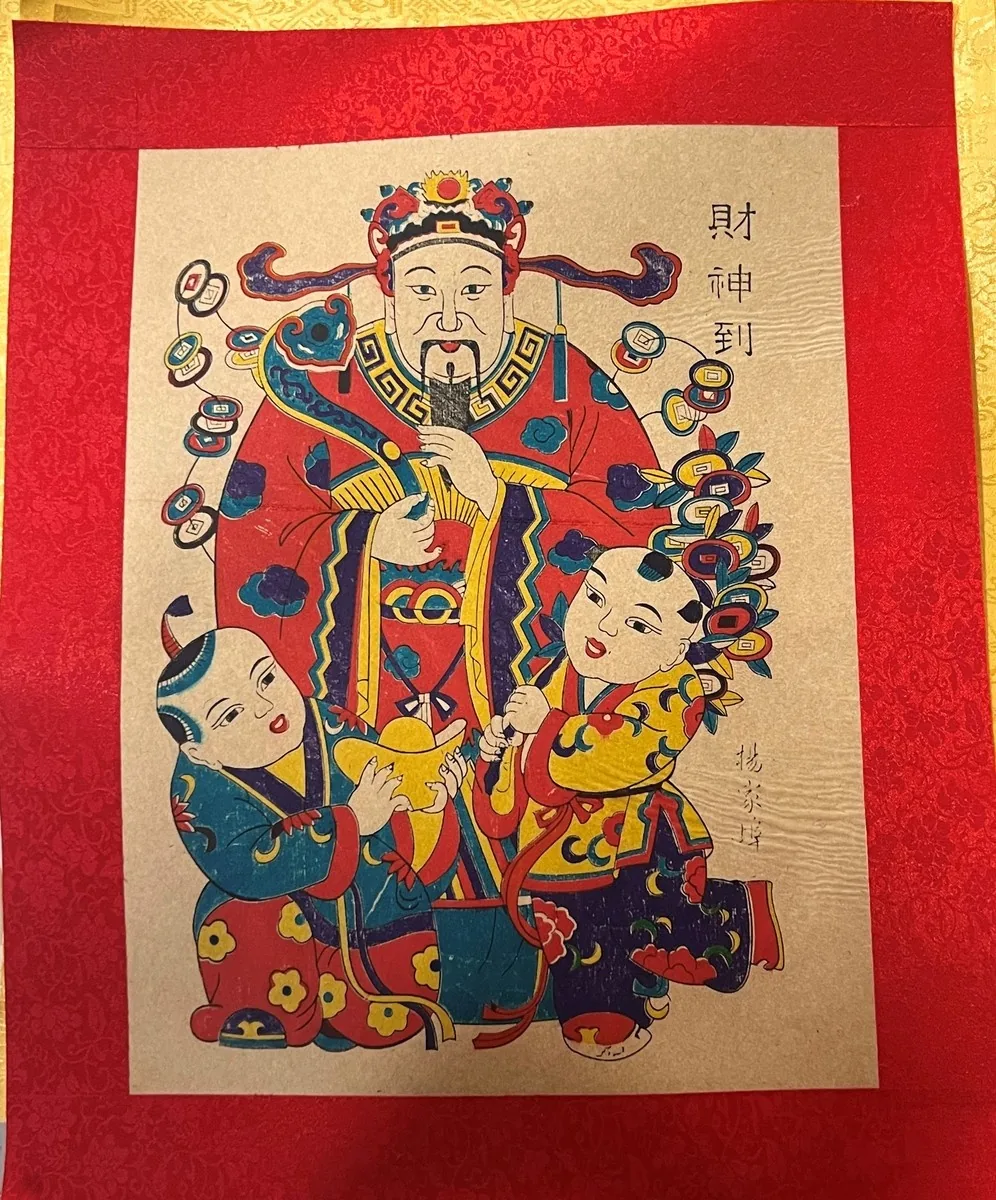
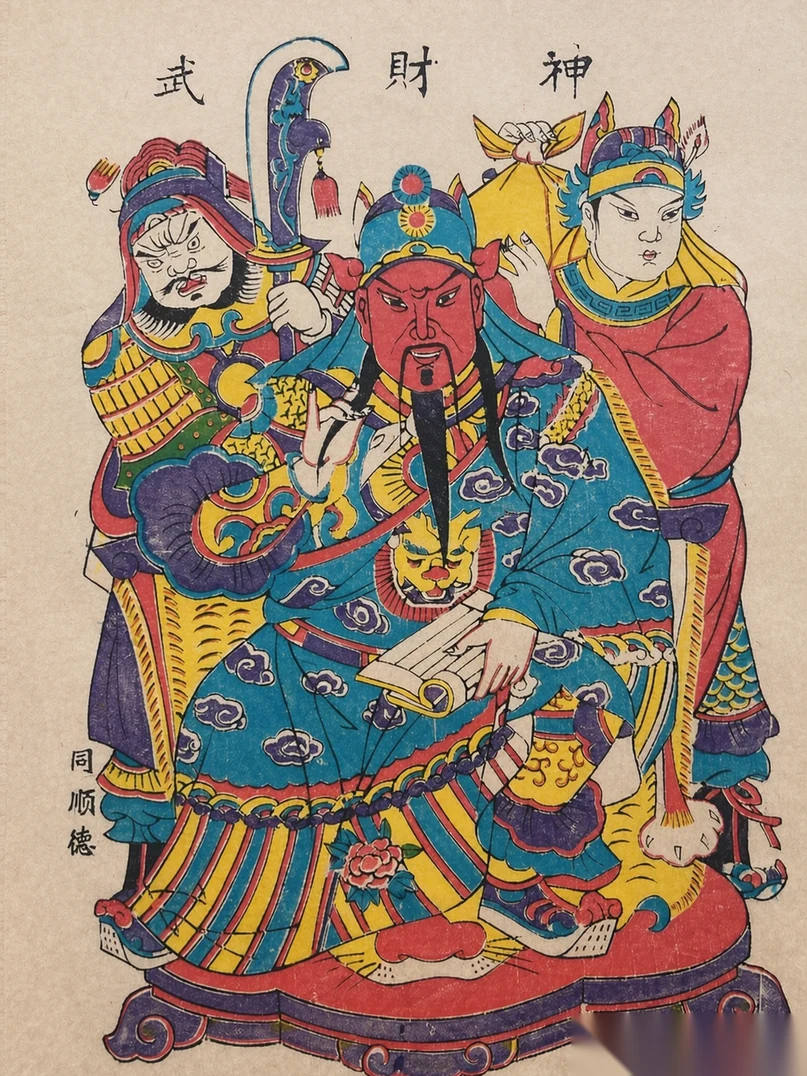
One block per colour. A four-colour print means four blocks, each carved so that it prints only its own area, and each registered to the others by eye and by pin. The keyline block — usually black — is carved first and carries the drawing; the colour blocks are cut to fit inside it. A mistake in the keyline propagates through every later block, which is why it is the most expensive one to get wrong.
Carving is done on seasoned pear or jujube wood, along the grain for the outline and across it for large flat areas. A block can be recut when it wears, and often was; the repair is sometimes visible in the impression.
3. The ink and colour
Traditionally mineral and plant pigments bound with animal glue, ground and mixed by hand. Modern workshop practice varies — some colours are now bought ready-mixed. The visible consequence is in the reds: mineral cinnabar ages towards brick, while a synthetic red stays brighter and flatter for longer.
4. Printing
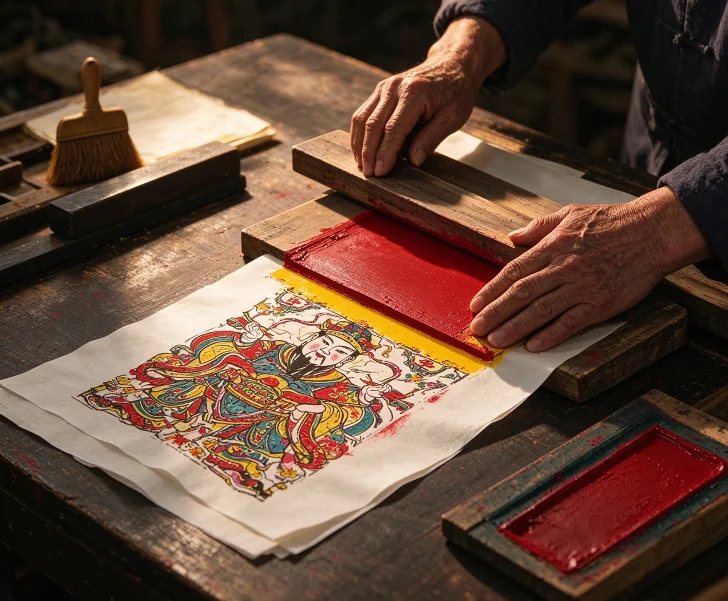
Paper is laid on the inked block and rubbed by hand — a dry pad, not a press. The pressure of a hand is uneven, which is exactly what gives a hand-pulled sheet its slight variation in density. Each colour is a separate pass, and each pass must register onto the previous one while the paper is still damp enough to take the ink without stretching.
5. Drying and finishing
Sheets are hung to dry between passes. Paper shrinks as it dries, so the sequence matters: print too much colour too quickly and the registration drifts across the sheet. The trim at the end is done by hand, which means the paper edge is not guaranteed square to the printed image.
What this means for a buyer
- Registration will vary. Expect a millimetre or two of drift between colours. It is the signature of the process, not a defect to be claimed against.
- Colour will vary between impressions and between batches. Successive pulls from one block thin out as the ink is used up.
- Paper edges are hand-trimmed. If you are framing to a fixed aperture, allow for a trimmed margin rather than assuming a precise sheet.
- The block records its own history. Worn areas, recuts and ink build-up are part of the object.
We describe what the workshop confirms. Where a specification — paper weight, pigment type, packing — has not been confirmed in writing, it does not appear on this site.